An Astrolabe That May Never Have Measured a Star
I have owned this astrolabe for around forty years.
I bought it from an antique shop in Switzerland in the 1980s, long before it became possible to photograph an object, press a button and receive twenty confident opinions about what it might be.
It was sold as an old astrolabe.
And old it certainly appears.
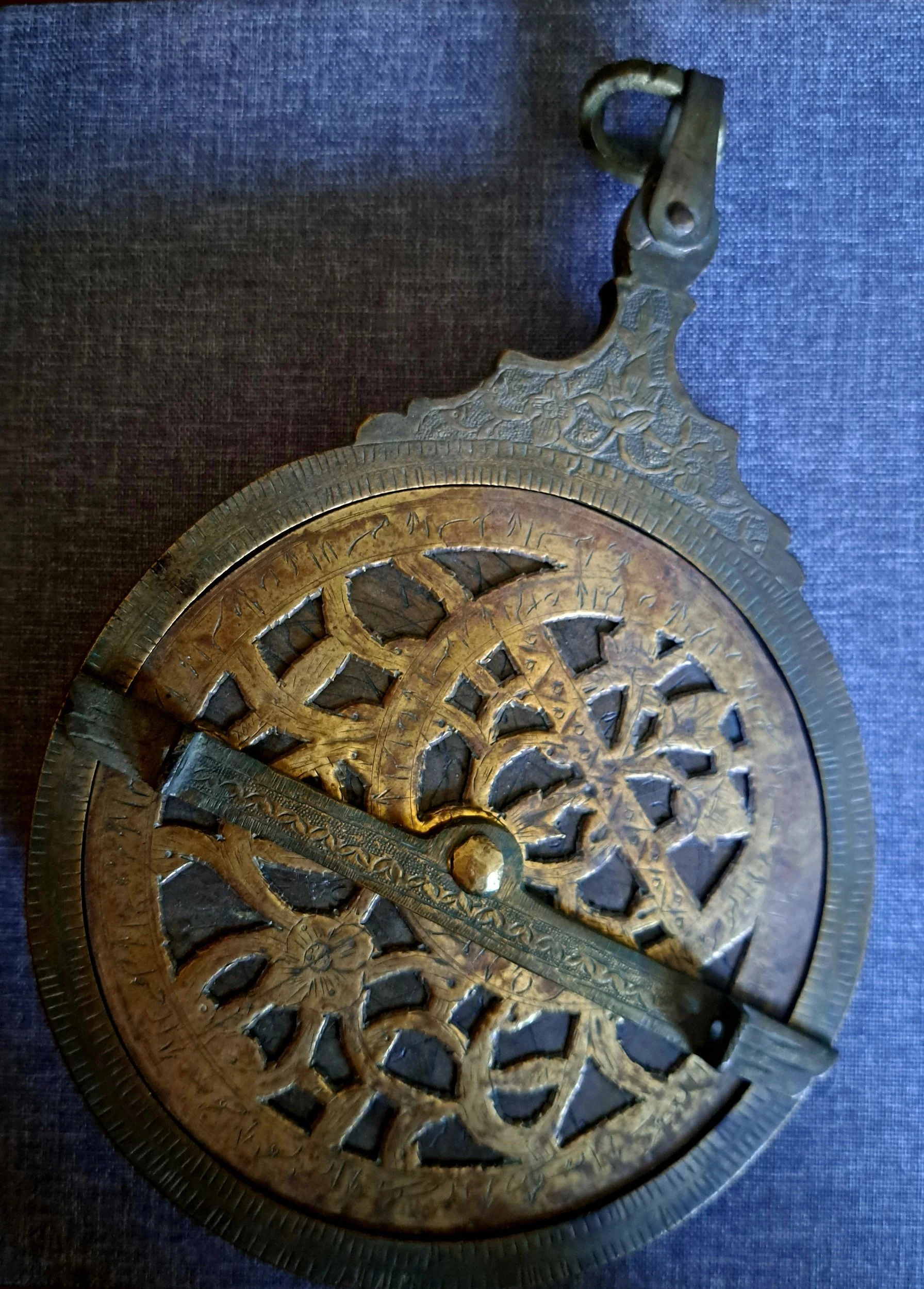
Heavy brass, darkened by time. Arabic inscriptions engraved across its surfaces. A delicate openwork disc. Moving arms, pointers, scales and several interchangeable plates hidden inside the body.
It looks like an instrument designed to understand the heavens.
And that is exactly what an astrolabe was.
For more than a thousand years, astronomers, navigators and scholars used astrolabes to translate the movement of the sky into something that could be held in the hand. With one, it was possible to determine the altitude of a star, calculate time, establish direction and solve astronomical problems that today disappear invisibly inside a phone.
The Islamic world brought the astrolabe to extraordinary levels of sophistication. Mathematics, astronomy and metalworking came together in instruments of remarkable precision.
This one has many of the right pieces.
The circular body, or mater, contains interchangeable plates. Above them sits the rete, an openwork representation of the heavens. On the reverse is an alidade, the rotating sighting rule used to measure the altitude of a celestial object. At the top, a ring allowed the instrument to hang vertically while an observation was made.
Everything seems to say: scientific instrument.
But then you look more closely.
The engraving is not as precise as one would expect from an instrument whose purpose depended upon mathematical accuracy. Some lines wander. Some inscriptions appear more decorative than functional. The geometry of the plates does not immediately have the rigorous construction found on serious astronomical instruments.
Perhaps this astrolabe never measured a star at all.
An old object pretending to be an older one
During the late nineteenth and early twentieth centuries, Europe developed an enormous appetite for objects associated with what was then called the Orient.
Collectors wanted Islamic metalwork, manuscripts, ceramics, weapons, scientific instruments and anything carrying the visual language of an imagined Middle East.
Where collectors appear, a market follows.
Old forms were copied. Objects were recreated. Sometimes they were honest decorative reproductions. Sometimes they were made in traditional workshops for foreign buyers. Sometimes they were deliberately aged or presented as something considerably older than they really were.
Astrolabes were particularly tempting.
Few European buyers understood how one actually worked, but almost everyone could appreciate the mystery of an engraved brass disc covered in Arabic script and astronomical symbols.
Museums today contain examples of these objects. The Science Museum in London, for example, catalogues several brass Islamic-style astrolabes dating from approximately 1890–1930 as later copies or "fake Islamic astrolabes."
And my instrument appears to belong somewhere in this complicated world.
Not medieval.
Probably not an important astronomical instrument.
But very possibly genuinely old.
Based on its construction, engraving, patina and comparison with documented examples, a date somewhere around the end of the nineteenth or beginning of the twentieth century seems plausible. Its precise place of manufacture remains uncertain.
And I rather like leaving that uncertainty visible.
Forty years on my shelf
When I bought it in Switzerland approximately forty years ago, none of this particularly concerned me.
I simply liked the object.
That is perhaps the most honest reason for buying anything.
Over the following decades it travelled with me. Houses changed. Countries changed. Cameras certainly changed. The astrolabe remained.
For much of that time I accepted what it appeared to be: an old astronomical instrument.
Only much later did the more interesting question emerge.
What if it isn't?
There is a peculiar tendency when dealing with old objects to believe that discovering something is not what we thought somehow diminishes it.
I think the opposite can happen.
If this were a medieval Islamic astrolabe, its story would largely belong to museums, scholarship and the history of astronomy.
If it was made around 1900 to satisfy the European fascination with an imagined Islamic past, then it tells another story entirely.
It becomes an object about collecting.
About authenticity.
About the nineteenth-century European fascination with distant cultures.
About craftsmen producing objects for people who wanted to possess a little piece of another world.
Perhaps somebody deliberately made it look centuries old.
Perhaps a dealer sold it as such.
Perhaps another dealer bought it.
Eventually, decades later, it arrived in an antique shop in Switzerland.
And then I walked in.
Looking at the stars
There is still more to discover.
The inscriptions may eventually reveal where it was made. Comparison with other examples may narrow the date. A specialist may determine whether some of its scales are genuinely functional or merely imitate astronomical notation.
That uncertainty is part of the object now.
An astrolabe was designed to answer questions by looking at the heavens.
This one has done almost the reverse.
For forty years it has sat quietly on Earth, generating questions of its own.
Who engraved it?
Where?
Was it intended to deceive, to decorate, or simply to fascinate?
And did anyone, even once, hold it vertically, sight along its alidade and point it towards a star?
I don't know.
After forty years, I find that rather more interesting than pretending that I do.
THE OBJECT
Probable date: c. 1890–1930
Origin: Uncertain, probably made in the Islamic world or for the European Orientalist market
Maker: Unknown
Material: Engraved brass
Type: Islamic-style planispheric astrolabe, probably decorative or pseudo-scientific
Components: Mater, rete, alidade, suspension ring and interchangeable plates
Provenance: Purchased from an antique dealer in Switzerland, c. mid-1980s
STATUS: Collection
This object is currently not for sale.