Photography Is Easy
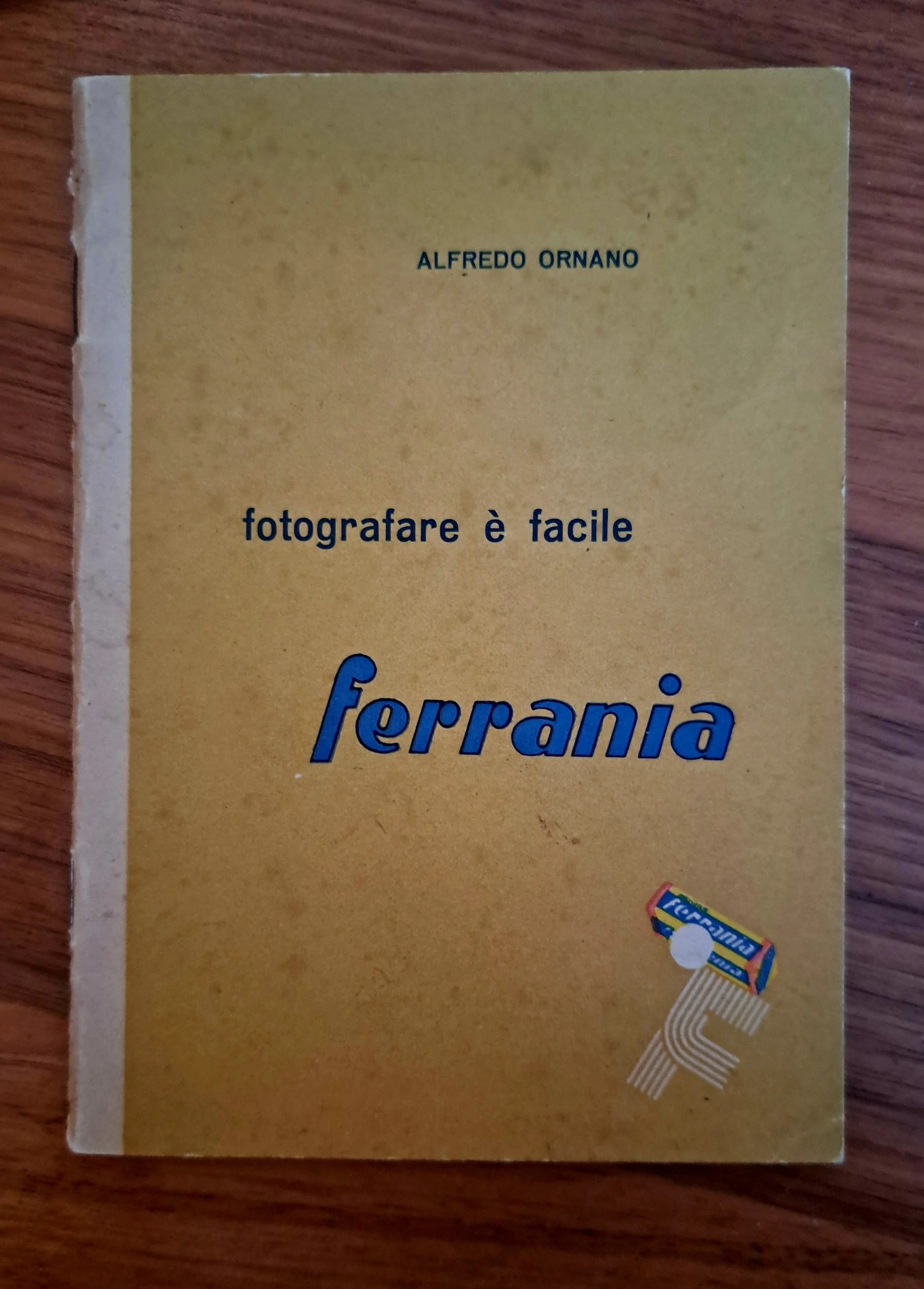
In November 1953, Alfredo Ornano published the sixth edition of a small handbook with an almost provocative title:
Fotografare è facile.
Photography is easy.
It sounds remarkably modern. Every generation of camera manufacturers has made roughly the same promise since: don't worry about the machinery, press the button and make photographs.
But in Italy in 1953, the promise meant something rather different.
Photography was becoming part of ordinary life.
The book was published by Ferrania, one of the great names of the Italian photographic industry, and the small line printed on its title page reveals exactly what it was: Propaganda Ferrania N. 2.
Today the word propaganda sounds rather sinister. Here it meant something closer to promotion or publicity. Yet this was more sophisticated than an advertisement disguised as a manual.
Ferrania was helping to teach Italians how to photograph.
And Alfredo Ornano was a serious person to do the teaching.
Born in 1880, Ornano belonged to the generation that had watched photography change from a technically demanding process into a mass medium. He had been associated with Agfa in Italy, helped found the Circolo Fotografico Milanese in 1930, wrote extensively about photographic technique, and after the war became one of the central figures behind Ferrania's influential magazine of photography, cinema and visual culture.
So this modest booklet sits at an interesting crossroads.
On one side was photographic culture: exposure, composition, processing, colour, criticism and the idea that photography could be taken seriously.
On the other was an industry that needed people to buy cameras, film, paper and chemicals.
Ferrania understood that the two could grow together.
Its magazine, launched in 1947, became an important forum for Italian photography while simultaneously promoting the company's products. Researchers today study its 251 issues as a record of Italian amateur photographic culture in the two decades after the war.
Fotografare è facile belongs to the same ecosystem.
Teach someone to understand exposure and you have created a more confident photographer.
Create a confident photographer and sooner or later they need another roll of film.
By the time this copy was printed in November 1953, the book had reached its sixth edition. That alone suggests the formula worked. A current antiquarian listing for the same 1953 edition describes a compact 31-page illustrated booklet, exactly the sort of inexpensive object that could circulate far beyond specialist photographic circles.
There was another reason the timing was perfect.
Ferrania was also selling cameras aimed at newcomers. Its Ibis, introduced in 1952, was promoted specifically to young people and those unfamiliar with photography. Simple camera, accessible instruction, readily available film: the barriers were quietly being removed one by one.
And then there is the title.
Fotografare è facile.
Seventy-three years later it has become almost literally true.
A telephone can recognise a face, calculate the exposure, stabilise the image, combine several frames and decide how the finished photograph should look before the photographer has thought about any of it.
Taking a photograph has never been easier.
Which makes this little Ferrania booklet unexpectedly contemporary.
Because Ornano's title was only half right.
Taking a photograph is easy.
Knowing why to take it never was.
THE OBJECT
Date: November 1953
Origin: Italy
Author: Alfredo Ornano, 1880–1955
Publisher: Ferrania
Edition: Sixth edition
Series: Propaganda Ferrania No. 2
Material: Printed paper, card cover
Dimensions: 12 x 10
Found: Italy
STATUS: Available
For Sale: €25