The Tailor at Number 24
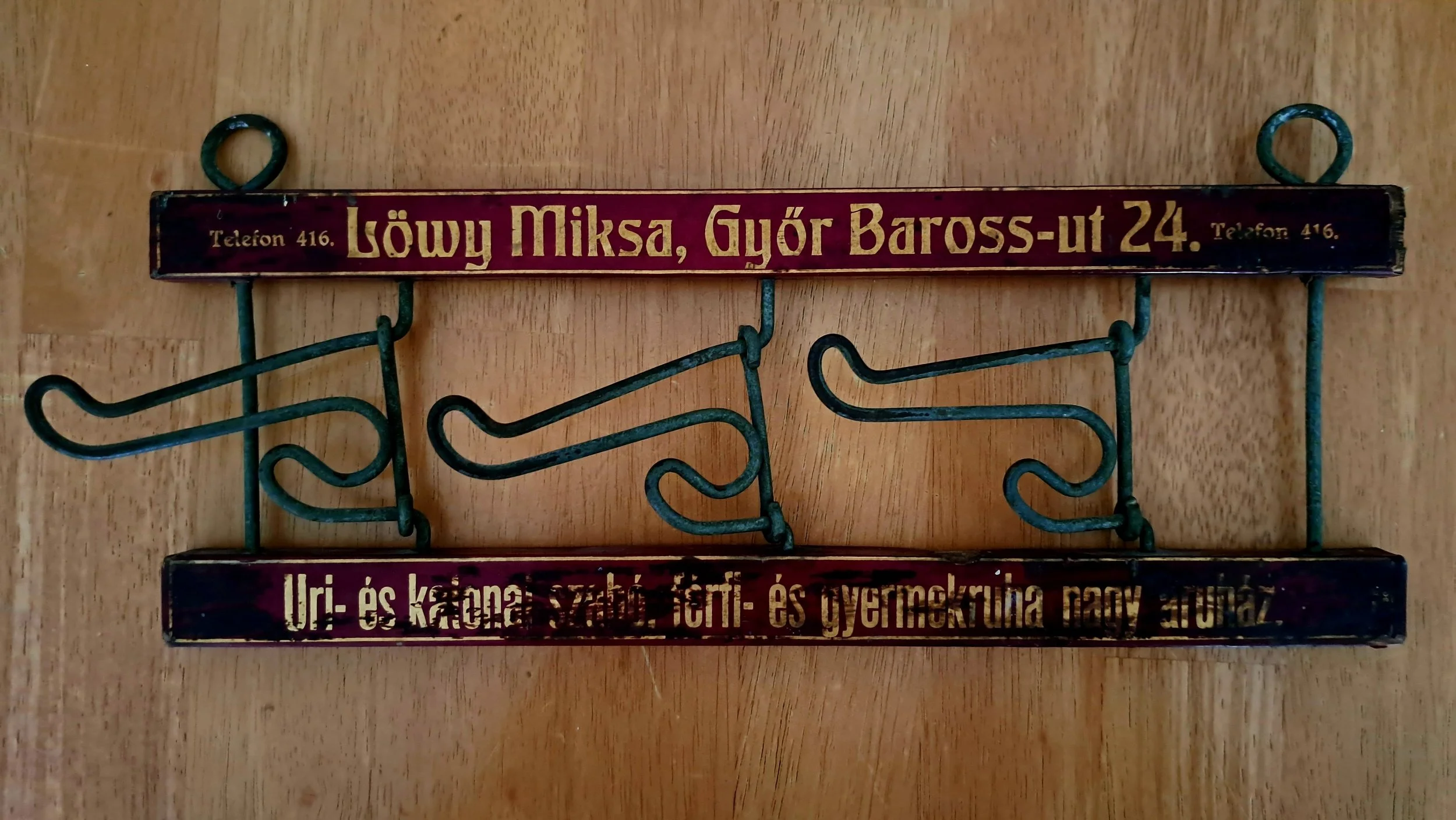
A wooden rack, four iron hooks, fading red paint and a telephone number that needs only three digits.
At first glance, there is not much to it. But painted across the upper rail is an address: Löwy Miksa, Győr, Baross-út 24. Telefon 416. Below it, another line explains the business more fully: Úri- és katona szabó, férfi- és gyermekruha nagy áruház. Gentlemen’s and military tailor, with a large store for men’s and children’s clothing.
The rack had done exactly what advertising was supposed to do. More than a century later, it still told us where to look.
Löwy Miksa appears in the Hungarian commercial record in February 1897, registered in Győr as the proprietor of a men’s tailoring business. By around 1915 his shop was sufficiently established to appear on a postcard, identified specifically as Löwy Miksa’s Gentlemen’s and Military Tailoring shop.
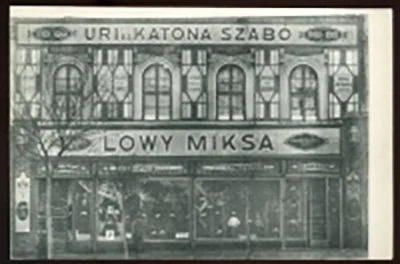
The military part matters. Győr was then a city of the Austro-Hungarian monarchy, and a tailor advertising himself to both civilians and soldiers was working in a world where uniforms were part of everyday urban life. Officers required privately fitted uniforms, coats and formal dress, while civilian customers still lived in a culture where a well-cut suit was expected to last for years.
Somewhere in that shop, perhaps before the First World War or during its early years, this rack carried clothing bearing Löwy’s name. A customer collecting a coat or uniform would have seen the same painted lettering that survives today.
The telephone number makes the object particularly evocative: 416. Nothing more was necessary.
A surviving hand-sewn tailcoat attributed to Löwy Miksa and dated to around 1910 suggests that garments from the shop have also endured. Your rack is therefore not an isolated piece of decorative advertising. It belongs to a real business whose activity can still be traced through official records, postcards and surviving clothing.
The building itself continued its commercial life long after Löwy’s name disappeared. By 1959, Baross Gábor út 24 was photographed as Győr’s Állami Áruház, the State Department Store. The address remains a busy retail location today.
And that is perhaps the nicest part of the object. The shop changed. The city changed. The monarchy vanished, then the world in which a “military tailor” could advertise himself on the high street vanished with it.
But somebody kept the rack.
THE OBJECT
Probable date: 1897-1920
Origin: Hungary
Maker: Löwy Miksa
Material: Wood and Metal
Dimensions: 30 cm
Found: Szentgotthárd, Hungary
STATUS: COLLECTION
This object is currently not for sale.