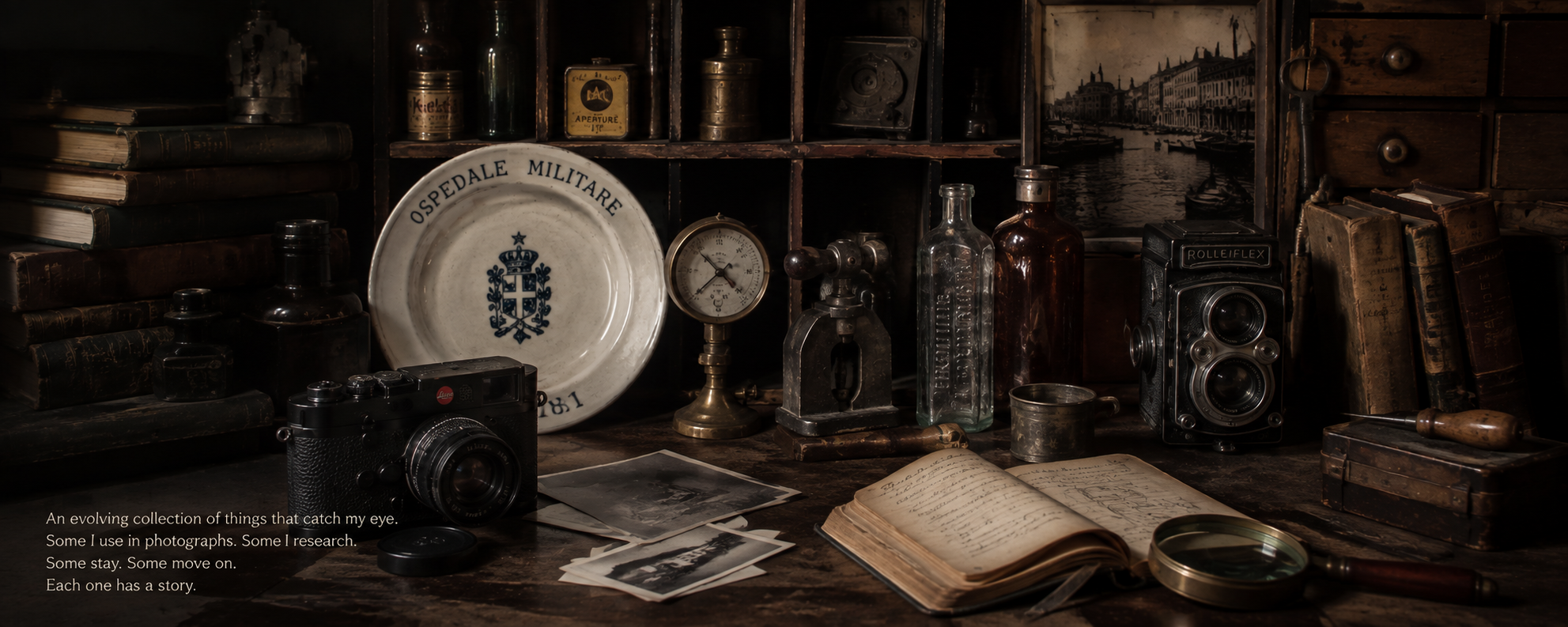
The Camera That Started Everything
Some objects enter your life quietly and only much later reveal what they actually meant.
This Leica M3 was one of them.
I was born in 1959. The camera was made in Wetzlar in 1962, when I was three years old. According to Leica's production records, serial number 1047661 belongs to a batch of M3 cameras produced that year.
So, in a peculiar way, the camera was already waiting for me.
Nearly two decades later, my parents gave it to me as a present. I cannot now remember whether I was eighteen or twenty-one. Memory is annoyingly selective about these things. I remember the camera. I remember that it came from my parents. The precise birthday has disappeared somewhere along the way.
It was my first camera.
Not my first Leica. Not my first serious camera.
My first camera.
And what a strange place to begin.
By the late 1970s the Leica M3 was already an old-fashioned machine. Introduced in 1954, it belonged to another photographic generation. There was no autofocus, no programme mode, no electronics deciding anything on your behalf. In fact, there wasn't even a built-in light meter.
You chose the aperture. You chose the shutter speed. You focused through the rangefinder. You loaded a roll of 35mm film and had 36 photographs before opening the camera again.
That was more or less the arrangement.
The M3 had originally been revolutionary. Its combined rangefinder and viewfinder, bright 0.91× finder and automatically selected frame lines transformed Leica's rangefinder cameras. But none of that mattered particularly to the young man who received this one.
I just had a camera.
And I started taking photographs.
Learning to Look
Looking at it today, I realise how much the M3 taught me without ever announcing that it was teaching anything.
A mechanical camera places very little between a photographer and a mistake.
If the exposure is wrong, you chose it.
If the photograph is out of focus, you focused it.
If you stood in the wrong place, no lens or processor was going to rescue you.
And because film cost money, photographs weren't entirely free either. Thirty-six exposures encouraged a certain degree of negotiation with yourself before pressing the shutter.
Is there actually a photograph here?
I certainly didn't formulate it quite so elegantly at eighteen or twenty-one. I probably just didn't want to waste film.
But the habit stayed.
Decades later, after countless cameras, assignments, countries, darkrooms, digital files and millions of shutter releases, I still believe that one of the most useful things a photographer can learn is when not to take the photograph.
Perhaps some of that began here.
Before Photography Became My Life
There is another reason this camera belongs in The Cabinet.
When my parents gave it to me, nobody knew what photography would eventually become in my life.
Certainly I didn't.
It was simply a present.
There was no grand family declaration that their son was destined to become a photographer. No cinematic moment when I lifted the Leica to my eye and suddenly understood my future.
Life is rarely that cooperative with storytellers.
I photographed because I enjoyed photographing.
Then I photographed more.
Years passed. Photography became increasingly important, then eventually became work. Cameras stopped being precious objects and became tools. They were carried through rain, knocked against things, packed for assignments, changed when technology changed and occasionally sworn at when they refused to behave.
Photography became a profession.
The M3 remained.
My Father and Another Camera
And now there is a coincidence I only properly appreciated while putting together The Cabinet.
My father was born in 1919. Among the things of his that eventually came to me was a tiny metal object called The Kombi.
For years it was simply one of those peculiar family things that survive without explanation.
Only much later did I discover what it really was.
The Kombi was an American miniature camera and graphoscope from the 1890s, a remarkable little brass machine capable of both making photographs and viewing the resulting transparencies.
My father's old object was a camera.
Then my parents gave me a camera.
And I became a photographer.
I am very reluctant to turn coincidences into destiny. It makes for wonderful stories but rather dubious history. I have no evidence that my father's Kombi had anything whatsoever to do with their decision to give me the Leica. I don't even know how important the Kombi was to him.
So I won't invent the missing pieces.
But I am allowed to enjoy the coincidence.
More than a century after the Kombi was made, and more than sixty years after my M3 left Wetzlar, both cameras are still here.
One belonged to my father.
One was given to me by my parents.
And one of them started everything.
Still Here
The M3 carries its years remarkably well. and I still use it
There are small marks and signs of use, as there should be. I have no desire to make it look new. A camera that has survived more than sixty years should be permitted to show some evidence of having lived.
Its monetary value can be calculated. Leica M3s are collectible cameras and their prices depend on serial number, condition, originality, servicing and the lens accompanying them.
But that calculation becomes fairly meaningless with this particular one.
I could buy another M3.
I cannot buy this M3.
I cannot replace the moment when my parents gave it to me. I cannot replace the photographs I made while learning how to use it, or reconstruct the young photographer who once looked through that viewfinder without knowing where photography would take him.
That is the peculiar thing about objects.
Their market value and their real value sometimes have almost nothing to do with each other.
This Leica was made in 1962, when I was three years old.
Some fifteen or eighteen years later, my parents placed it in my hands.
I looked through it.
And, without knowing it, I began.
THE OBJECT
Object: 35mm rangefinder camera
Date: 1962
Origin: Wetzlar, West Germany
Maker: Ernst Leitz GmbH
Model: Leica M3
Serial number: 1047661
Finish: Chrome
Format: 35mm film
Provenance: Given to me by my parents when I was around twenty
In my possession: c. 1977–1980 to the present
STATUS: COLLECTION
This object is currently not for sale.