The Knocker from Sithean
There are objects whose history can be reconstructed from a maker's mark, a serial number or an inscription.
This isn't one of them.
There is no name on the back of this small metal figure, no date and no manufacturer's stamp. Even its precise age remains uncertain. Its construction and style suggest a British decorative door knocker from around the late nineteenth or early twentieth century, but without documentary evidence, that has to remain an attribution rather than a fact.
What we do know is where it came from.
Sithean.
That was the name of our remote cottage in Scotland.
The name is Gaelic. Sìthean, pronounced roughly shee-an, means a fairy hill or fairy mound, one of those green or hidden places traditionally associated with the sìthichean, the fairy folk.
These were not quite the harmless, winged fairies that later appeared in children's books. In Scottish tradition, the supernatural world could be beautiful, troublesome and occasionally dangerous. Certain hills, mounds and lonely places were treated with respect because they were believed to belong, at least partly, to somebody else.
Over generations, stories surrounding hidden and underground places also became entangled with darker Scottish folklore: unexplained gatherings, spirits, witchcraft and things that happened away from ordinary eyes.
None of this proves anything supernatural about our cottage, of course.
But Sithean was a rather wonderful name for a remote Scottish house.
And on its door was this fellow.
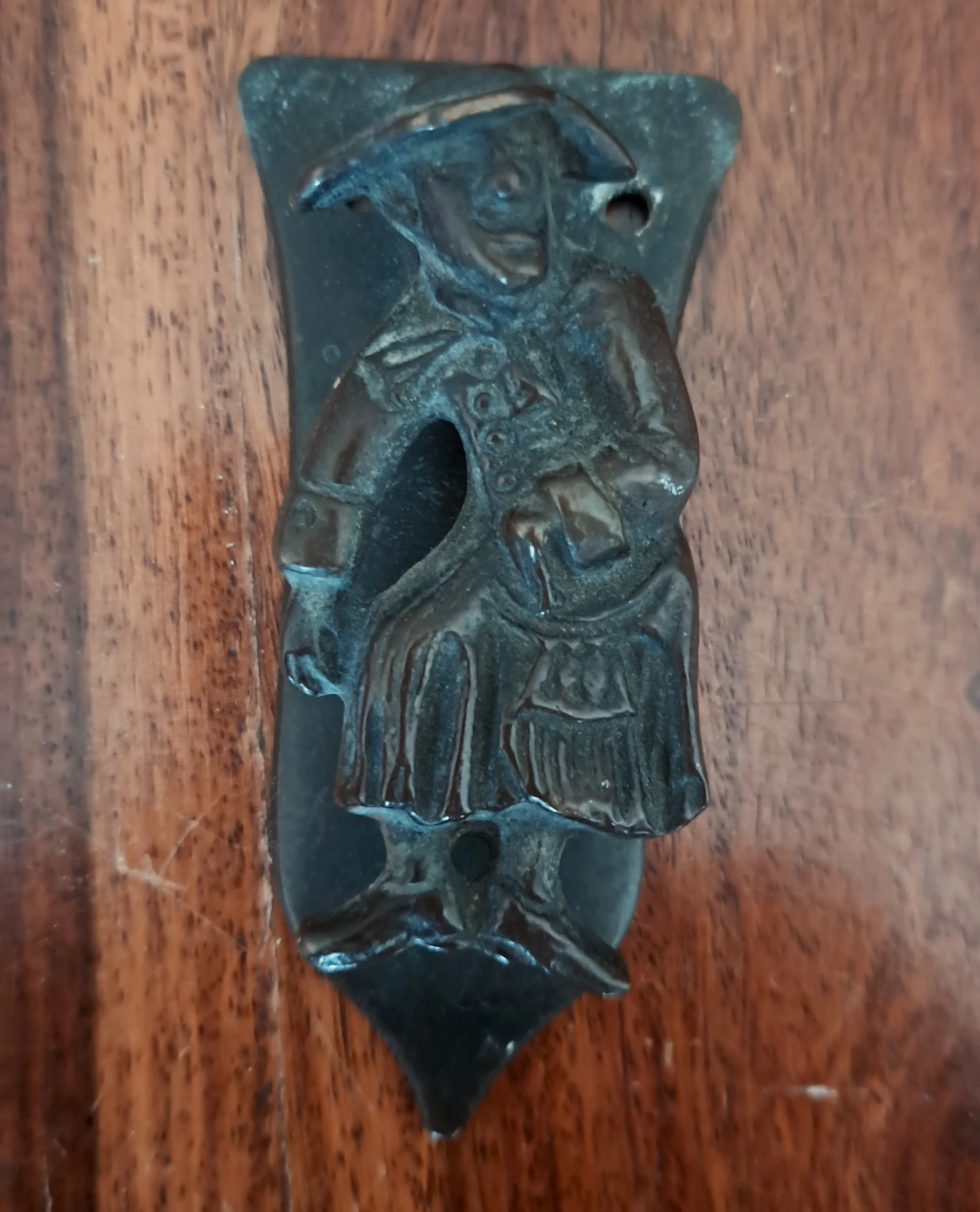
At first glance he looks like a small and rather eccentric metal figurine. He wears an exaggerated old-fashioned costume, with a broad hat, coat and pleated clothing. His features are more caricature than portrait. There is something slightly theatrical about him.
Turn him over and his purpose becomes obvious.
His shoulders form a hinge. The figure lifts away from the backplate and falls against it. The character himself is the hammer.
A door knocker reduced to the simplest possible mechanism.
Lift him.
Let him fall.
Someone inside knows you are there.
That simplicity is also what makes the object interesting today.
A door knocker spends almost its entire existence attached to a building. It isn't normally collected, carried around or even particularly noticed. It simply waits beside a door until somebody arrives.
And every arrival repeats the same gesture.
A hand reaches forward, takes hold of the metal figure, lifts it and lets it fall.
Knock.
Then somebody waits.
Look closely at this one and part of that history survives physically in the object. Much of the metal has darkened with age, while the areas involved in movement and impact are smoother and brighter.
It has been polished, but not necessarily by somebody with a cloth.
It has been polished by use.
How many people knocked on the door of Sithean before we lived there, I have no idea.
Neighbours perhaps. Friends. Tradesmen. The postman. Someone sheltering from Scottish weather. Somebody who had taken a wrong turning. People who were expected and others who most certainly weren't.
Each of them would have picked up the same little metal figure.
And then there were our own years there.
That is where this object becomes something different from an anonymous piece of old British hardware.
Its maker may be unknown. Its exact date may remain uncertain. It may never prove particularly rare or valuable.
But we know its door.
We know the house behind that door.
We know its name.
When we eventually left Sithean, the knocker came with us.
Removed from the timber and separated from the house it had served, it became a strange little object. Without its context, it is difficult even to understand what it is. The figure seems almost decorative until you turn it sideways and discover the hinge and the striking plate.
Yet perhaps that is exactly why it deserves to survive.
Antiques are often valued because we can identify who made them. Sometimes because they are scarce. Sometimes because somebody important owned them.
Personal objects work differently.
Their significance can come simply from having been present.
This little figure once stood at the boundary between a remote Scottish cottage and everyone who came to its door. For years, lifting him was the final small act before entering Sithean.
The fairy hill.
Today he no longer knocks.
But he came with us.
THE OBJECT
Probable date: Late 19th to early 20th century
Origin: Britain, possibly Scotland
Maker: Unknown
Material: Cast metal, probably brass or bronze
Function: Door knocker
Provenance: Sithean, Gilmerton, Scotland
STATUS: COLLECTION
This object is currently not for sale.